Outdoor Fireplace Kit vs Masonry: Which Should You Build in Florida?
A prefab outdoor fireplace kit costs less and goes in fast. But the maker sets its size and look. A custom masonry outdoor fireplace costs more and takes longer to build. In return, it is sized and styled to your patio, your house and any outdoor kitchen beside it.
We build custom masonry outdoor fireplaces on site across Central Florida, so we have a side in this. Even so, a kit is the right call for some yards.
How do a fireplace kit and a masonry fireplace compare?
| Prefab unit or kit | Custom masonry fireplace | |
|---|---|---|
| How it is made | Partly assembled off-site by the maker | Built on site from raw materials |
| What it is made of | A metal unit, or precast concrete pieces lined with firebrick | A concrete block core, a firebrick-lined firebox, a brick or natural stone face |
| Install time | A prefab unit may take 2 to 4 hours; an unfinished kit takes longer | Longer, since it is built from raw materials |
| Size and shape | The maker’s set sizes and styles | Sized to the patio, the house and the opening you want |
| Cost | Less in labor and materials | More |
| Life span | 20 to 30 years, with quality and care | Longer than prefab, per the same guide |
| What goes under it | A concrete pad; one kit maker’s guide asks for a minimum of 4 to 6 inches | A footing at least 12 inches thick, under the code’s masonry rules |
What is an outdoor fireplace kit?
Outdoor fireplace kits come two ways. A prefabricated unit arrives partly built. A national cost guide says manufacturers partially assemble these kits off-site, so they go in faster than raw materials. It says a prefabricated fireplace may take only 2 to 4 hours to build.
An unfinished kit is a set of loose parts. The same guide calls these non-assembled kits and says they take longer to install than prefab units.
A kit is not always metal. The guide says metal outdoor fireplaces are usually premade. Other kits are concrete. One kit maker lists precut concrete blocks for the shell and a firebrick lining for the firebox. Its blocks stack and glue together, with high-strength adhesive in place of mortar.
What does a custom masonry outdoor fireplace involve?
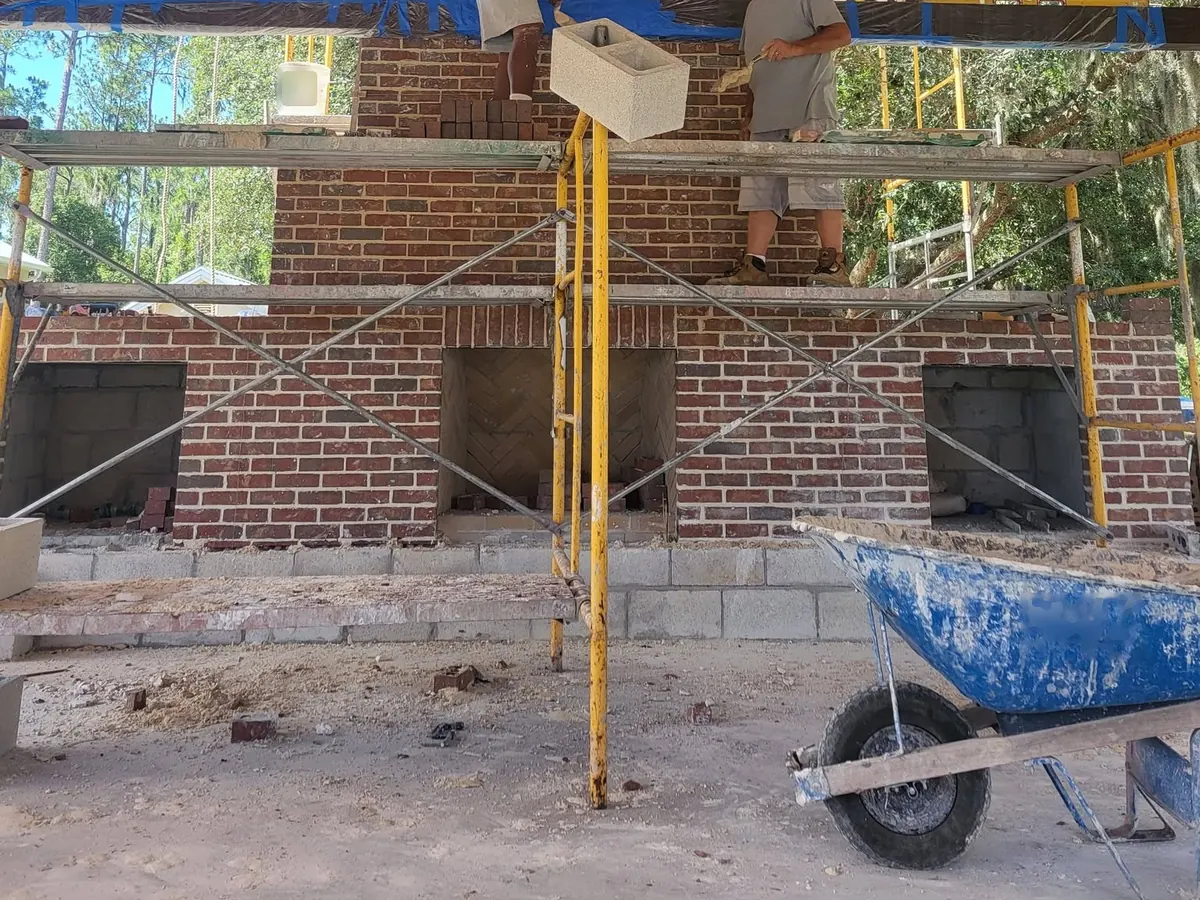
A masonry outdoor fireplace is built in place. Ours start with a concrete block core. The firebox, where the fire burns, gets a firebrick lining, since firebrick is made for the heat. Real clay brick or natural stone covers the face. The hearth matches it, and the chimney gets a cap.
Where firebrick lines a masonry firebox, the Florida Building Code calls for a lining at least 2 inches thick. Joints between firebricks can be no wider than 1/4 inch. The firebox must be at least 20 inches deep, though the code allows a shallower Rumford design.
We build wood-burning masonry fireplaces. A gas log set and its gas line are work for a licensed gas contractor.
What does each one cost?
A national cost guide gives these ranges. They are market numbers, not our price list.
- A prefabricated outdoor fireplace: $1,500 to $9,000 installed
- An unfinished kit: $1,000 to $4,000
- A custom outdoor fireplace: $6,000 to $20,000 installed, built to your specifications
The same guide puts stone or brick for an outdoor fireplace at $1,500 to $8,000 in materials alone. It says prefab fireplaces cost less in labor and materials but are not customizable.
How much can you shape each one to your yard?
A kit comes in the maker’s sizes. One kit maker’s line runs from about 40 inches wide to about 96 inches wide. Some kits can be faced with a veneer, but the size and shape stay the kit’s.
A custom masonry fireplace starts from your space. A national cost guide says a custom build lets you control its size, material, style and add-on features. On a fireplace we build, that can mean:
- a firebox sized and shaped to the opening you want
- a herringbone firebrick back, with the firebrick set at angles in a zigzag
- log-storage niches built into the sides
- clay brick or natural stone picked to go with the house
A fireplace and an outdoor kitchen built in masonry can also go up as one project. For the kitchen side of this choice, see our prefab vs masonry outdoor kitchen guide.
How do Florida sun and rain treat each one?
NOAA’s 1991 to 2020 normals put Orlando’s yearly rain at 51.45 inches. More than half of it falls from June through September. Block and brick do not rust or rot. For masonry chimneys, the Florida Building Code calls for a concrete, metal or stone cap, sloped to shed water.
Rain shapes the build, too. A concrete masonry industry guide says masonry work should not continue in heavy rain unless it is protected. Fresh mortar can wash out. In a wet Central Florida summer, a masonry fireplace can take longer to finish.
For a kit, ask the maker how its finish holds up to Florida sun and humidity.
What goes under a kit or a masonry fireplace?
Both need concrete under them. One kit maker’s guide calls for a concrete pad with a minimum thickness of 4 to 6 inches. It adds expansion joints where the pad ties into an existing patio or slab.
For masonry fireplaces, the Florida Building Code calls for a concrete or solid masonry footing at least 12 inches thick. The footing must reach at least 6 inches past the fireplace on all sides. Where the ground does not freeze, it must sit at least 12 inches below finished grade.
Under a covered patio, lanai or pavilion, the roof and the structure are the builder’s work. We build the fireplace; your builder handles the permit and the structure.
Do you need a permit or a burn approval?
The building department for your address decides whether an outdoor fireplace needs a permit.
The City of St. Cloud’s outdoor burning page shows how the rules can split. It says no permit is needed to burn a fire in a commercially manufactured outdoor fireplace that meets its rules. The unit must sit on a non-combustible surface, at least 10 feet from any structure and 6 feet from combustibles. The page does not say how it treats a fireplace built on site.
Check with your city or county and the fire department before the work starts. Our guide to outdoor fireplace permits in Central Florida covers the county rules and burn bans.
When does a kit make sense, and when does masonry?
A kit makes sense when:
- cost is the main concern, since prefab units cost less in labor and materials
- you want a fire on the patio soon, since a prefab unit can go in within hours
- one of the maker’s sizes already fits your space
A masonry fireplace makes sense when:
- this is your forever home, and the same cost guide says custom masonry fireplaces last longer than prefab ones
- the fireplace goes under a covered patio, built with your builder
- you want a fireplace and an outdoor kitchen built as one project
Where should you start?
If masonry fits, see how we build a masonry outdoor fireplace on site. We look at the space, and any roof over it, and give you a quote. Call (407) 702-4316, and we will get back to you.