Prefab vs Masonry Outdoor Kitchen: Which Holds Up Better in Florida?
A prefab outdoor kitchen goes in faster and costs less to start. You can also take it with you if you move. A masonry outdoor kitchen takes longer, but it is built to fit your grill and your house. One national cost guide rates block frames for excellent fire and weather resistance.
We build masonry outdoor kitchens across Greater Orlando, so we have a side in this. Still, a kit is the right call for some homeowners.
How do prefab and masonry outdoor kitchens compare?
| Prefab or modular kit | Masonry outdoor kitchen | |
|---|---|---|
| Frame | Aluminum or steel, shipped ready to assemble | Concrete block on a concrete slab or footing |
| Install time | Often 1 to 2 days, with no curing time | Longer, since block work is labor-intensive |
| Heat around the grill | Check the materials; a combustible enclosure needs an insulated jacket | Non-combustible masonry, built to the grill’s cut-out sizes |
| Florida weather | Less durable than masonry in severe climates | Excellent fire and weather resistance; block and brick do not rust or rot |
| Customizing | Limited | Openings sized to the grill, doors and drawers you pick |
| Moving it later | Portable and relocatable | Stays where it is built |
| Matching the house | May not match the home’s look | Faced in clay brick or natural stone |
The ratings come from one national cost guide and two grill makers’ installation manuals.
How is each type of outdoor kitchen built?
Both kinds are outdoor kitchens, or summer kitchens, as Florida often calls them. A prefab outdoor kitchen is also sold as a modular outdoor kitchen or an outdoor kitchen kit. One national cost guide describes kits as aluminum or steel frames shipped ready to assemble.
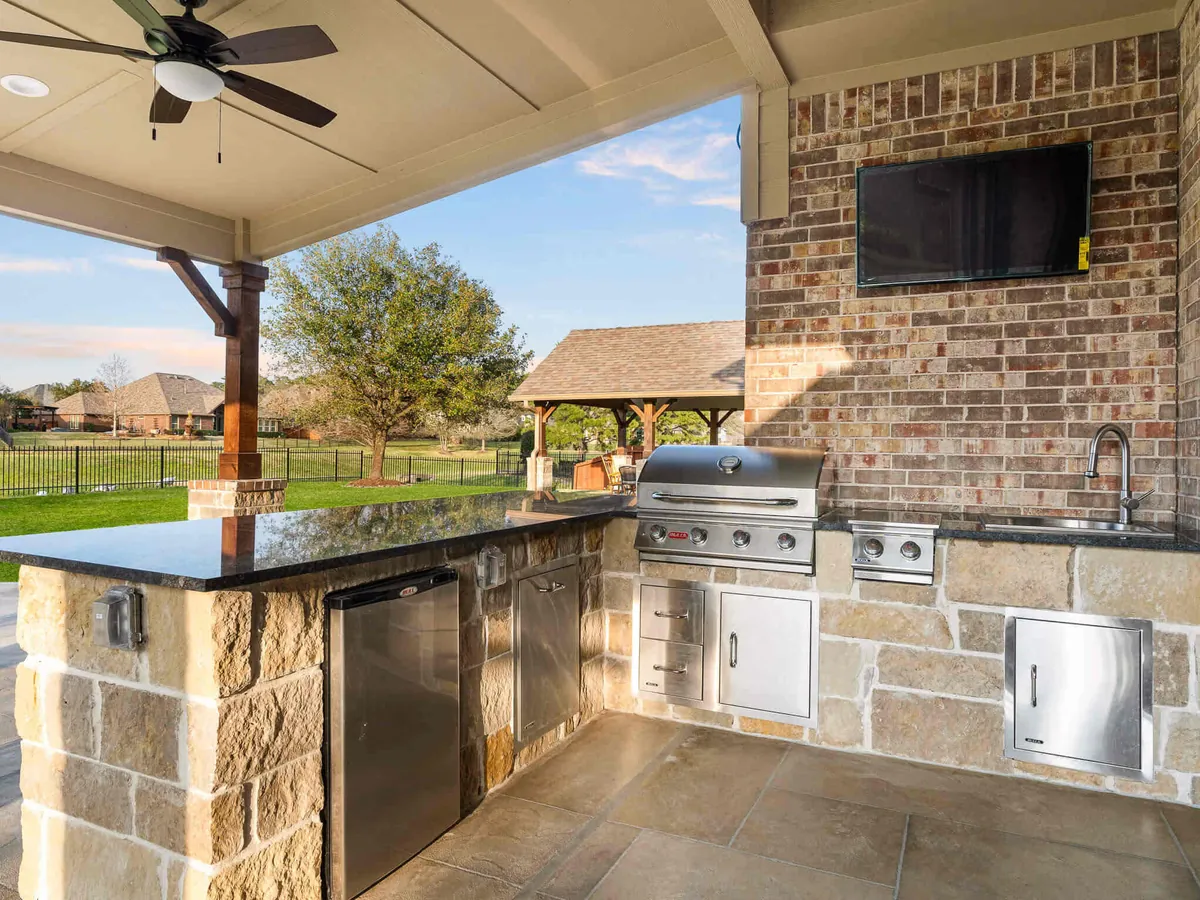
A masonry outdoor kitchen is built in place. Masons lay concrete block on a concrete slab or footing. Each opening is sized to the grill, doors and drawers you pick. Then the block is faced in clay brick or natural stone and left ready for the countertop.
The same cost guide calls block framing the most common custom approach. We build the whole kitchen as a masonry structure, instead of a metal or wood frame with a veneer skin.
Which one handles the heat of a built-in grill?
Grill makers’ installation manuals draw a line between combustible and non-combustible enclosures. Two manuals say a grill set into a combustible enclosure needs an insulated jacket or liner. One lists its own rough opening sizes for a non-combustible masonry enclosure.
A masonry base sits on the non-combustible side of that line. With a kit, find out what it is made of. Then read the grill’s manual and the kit maker’s specs.
Either way, the base under a gas grill needs vents. One manual requires vent openings in custom-built enclosures for every gas type. It warns that propane is heavier than air and can pool where venting falls short.
How do Central Florida rain, pools and salt air treat each one?
NOAA’s 1991 to 2020 normals put Orlando’s yearly rain at 51.45 inches. Block and brick do not rust or rot. One national cost guide calls prefab kits less durable than masonry in severe climates. It also says kit doors and drawers can loosen over time.
Both types hold a grill, access doors and drawers, so both have metal parts to look after. One grill maker’s manual says a grill near salt air or a chlorine pool is more prone to corrosion. It calls for more frequent cleaning there. Rust spots left alone can pit the steel, it warns.
Stainless steel also comes in grades. A stainless steel industry group calls grade 316 the first step up from grade 304. It resists pitting in chloride environments better, and it is often called the marine grade. One national cost guide calls for marine-grade steel in salt-air settings.
What happens during hurricane season?
NOAA’s National Hurricane Center says the Atlantic hurricane season runs from June 1 to November 30. It puts the peak on September 10.
A masonry kitchen is built in place on a concrete slab or footing. A kit is portable and relocatable, one national cost guide notes. That guide tells buyers to ask how the frame is anchored to the patio. It says anchoring matters for long-term stability and for permits.
Even do-it-yourself kits need careful site prep and leveling to keep the frame square, the guide adds. Wind ratings and tie-downs are questions for the kit maker and the building department for your address.
Which one can fit your grill and match your house?
Grill makers’ manuals list cut-out sizes for each grill. A masonry base is built to those sizes, at bar height or counter height.
One national cost guide lists limited customization as a kit drawback. It adds that a kit may not match the home’s look. A masonry kitchen can be faced in clay brick or natural stone picked to go with the house.
The floor around it can be mud-set brick or broom-finish concrete. A kitchen and an outdoor fireplace can also go up as one masonry project.
How long does each one take to build?
One national cost guide calls a prefab kit the fastest install, often 1 to 2 days with no curing time. Block work is labor-intensive, the same guide says, so a masonry kitchen takes longer. A new concrete slab also needs time to cure. A national concrete industry association says curing typically runs 3 to 7 days.
For a whole outdoor kitchen project, the same cost guide’s typical timeline is 2 to 6 weeks. That covers design and permit review, plus the frame and countertops. Permit review alone runs 1 to 3 weeks in that guide, and it varies by town.
Which one costs more?
A kit costs less to start. One national cost guide prices the modular prefab kit per linear foot, below a concrete block frame. It also credits kits with a lower total cost for basic builds. For the market ranges, not our price list, see what an outdoor kitchen costs in Florida.
Do you need a permit for either one?
The building department for your address decides whether an outdoor kitchen needs a building permit. Gas, electrical and plumbing work is a separate matter. A licensed plumber or gas contractor runs the gas line, and a licensed electrician handles the circuits.
The City of Orlando, for one, requires trade permits for electrical, plumbing and gas work. Check with the building department and your HOA before the work starts.
When is a prefab outdoor kitchen the right call?
One national cost guide says kits suit renters and homeowners who want a working setup fast, without a large investment. If you rent or may move soon, a kit can go with you. The same guide lists a propane-only modular kit on an existing patio, with no utility hookups, as a do-it-yourself job.
Masonry makes more sense when you own the home and plan to stay. It also fits if you want a non-combustible base, or brick or stone that goes with the house.
How do you start a masonry outdoor kitchen?
Pick your grill and access doors first, since the openings are built to their sizes. Plan the gas line with a licensed plumber or gas contractor, and any power with a licensed electrician.
We are based in St. Cloud and build outdoor kitchens as a full masonry structure across Greater Orlando. We look at the space and give you a quote. Call (407) 702-4316.