
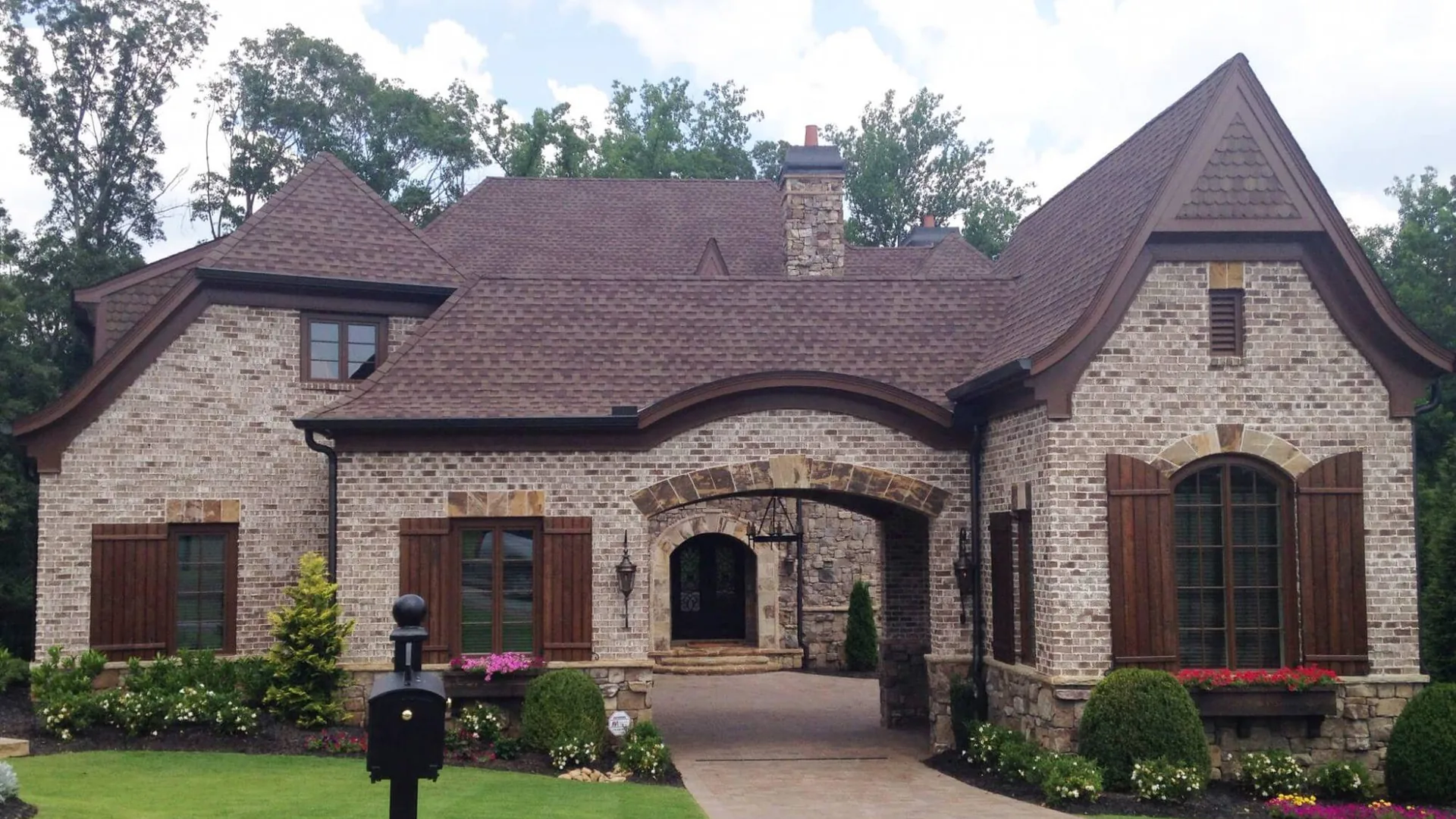
Natural Stone or Manufactured Stone Veneer: Which Fits a Florida Home?
Manufactured stone veneer usually costs less than natural stone and weighs far less. Natural stone costs more, and full-bed stone needs a ledge to stand on. Either one can work on a Florida house, as long as the drainage details behind it are right.
We build with natural stone masonry, so we have a side in this. This guide sticks to published numbers and code rules.
What is the difference between natural stone and manufactured stone veneer?
Natural stone is rock from a quarry. Full-bed stone is 4 to 6 inches thick and is laid up like a stone wall. Thin natural stone veneer is cut from the same stone and set against the wall in mortar.
Manufactured stone veneer is concrete cast to look like natural stone. The Concrete Masonry and Hardscapes Association (CMHA) now publishes the manufacturers’ installation guide. Its guide spec lists the mix: cement, lightweight aggregates, additives and coloring pigments. Building-enclosure engineers describe it as the look of masonry with the lower cost and weight of stucco.
How do the two compare side by side?
| Detail | Full-bed natural stone | Thin natural stone veneer | Manufactured stone veneer |
|---|---|---|---|
| Weight | 40 to 73 pounds per square foot | Lighter than full-bed | About a quarter of natural stone |
| What holds it up | A ledge or steel angle, plus metal ties | A mortar bond to the wall | A mortar bond to the wall |
| How water gets out | An air space and weep holes | A barrier and a weep screed | A barrier and a weep screed |
| Color | The stone’s own minerals | The stone’s own minerals | Iron oxide pigments |
| Stone cost per square foot | $5 to $30 | $9 to $15 | $5 to $10 |
| Labor per square foot | $9 to $15 | $3 to $12 | $3 to $12 |
The cost rows come from one national cost guide, updated in August 2025. They are market numbers, not our price list.
What does each one cost per square foot?
Full-bed labor runs higher because it takes longer to set, that guide explains. Its whole-job example is 1,500 square feet of manufactured stone veneer siding at $30,000 to $55,000 installed. That works out to about $20 to $37 per square foot. A second national guide prices manufactured stone at $5 to $8 per square foot for the stone alone.
How much does each weigh, and what holds it up?
Full-bed stone weighs 40 to 73 pounds per square foot, per the Natural Stone Institute. It stands on a concrete ledge or a steel angle and ties back to the house with metal ties. The Florida Building Code adds a termite rule here. It calls for brick or stone veneer to sit on a concrete ledge poured with the foundation.
Thin natural stone and manufactured stone veneer are adhered veneers. They bond to the wall with mortar and need no ledge. The Natural Stone Institute says thin stone goes over existing block or brick with no added support. A building trade magazine puts manufactured stone at about a quarter the weight of natural stone.
How is each one installed and drained?
Rain is the big test. Orlando averages 51.45 inches of rain a year, about 57 percent of it from June through September, per NOAA.
Adhered veneer follows the Florida Building Code and the CMHA guide spec. On a wood-framed wall, the layers go on in this order:
- Two layers of water-resistive barrier over the sheathing.
- Corrosion-resistant metal lath.
- A mortar scratch coat about 1/2 inch thick.
- A mortar setting bed, then the stone.
On bare concrete block with no coating, the setting bed can bond straight to the block. At the base, a weep screed or flashing lets trapped water drain out, and the barrier laps over it.
On framed walls, the code wants adhered veneer 4 inches above soil and 2 inches above paving. Its termite section asks for 6 inches between wall coverings and soil, for termite inspection. Your county or city building department applies these rules to your address.
Full-bed stone drains through an air space instead, nominally 1 inch over a framed wall. Flashing runs under the first course, with weep holes just above it no more than 33 inches apart. Brick veneer on a house follows the same anchored-veneer rules.
Fresh mortar needs care in Florida heat. Masonry rules guard new work against fast drying above 100 degrees, or above 90 with wind over 8 mph. Orlando’s normal July high is 92 degrees, per NOAA.
What goes wrong when stone veneer is installed poorly?
A home inspectors’ association notes that manufactured stone has no air space behind it on a framed wall. When rain soaks the veneer, it holds that water against the wall.
The engineers’ 2021 paper notes that the veneer itself is little affected by water. Over wood sheathing, though, wet sheathing swells and pushes on the veneer. That can crack units or pop them loose. Its list of common mistakes:
- Flashing lapped the wrong way, which sends water behind the barrier.
- Lath not fully embedded in the scratch coat.
- Movement between two different backings that was never planned for.
- Too little mortar on the back of each unit.
Thin natural stone is adhered veneer too, so the same details apply. The paper also covers freeze and thaw in trapped water. Orlando averages 1.6 days a year at or below 32 degrees, per NOAA, so rain matters more here.
How does each hold its color in Florida sun?
Natural stone gets its color from its own minerals. The Natural Stone Institute notes that it has no added oxide colors.
Manufactured stone is colored with iron oxide pigments. One maker explains that its units are colored on the face, over a plain gray or tan cement core. Cutting a unit exposes that core.
The inspectors’ association calls the pigment generally durable and says it will not fade. It adds that harsh chemicals and solvents can stain it. The same maker notes that iron oxides resist ultraviolet light.
What do ashlar and the other stone patterns mean?
The Getty Art and Architecture Thesaurus defines ashlar as stone with a flat face, usually square or rectangular. Coursed ashlar is laid in regular rows, each row an even height. Random ashlar mixes block sizes, so the joints do not line up evenly. Rubblework uses rough or roughly cut stone.
We cut and dress natural stone ashlar on site, with hammer and chisel, until the pieces fit. Manufactured stone is cast in molds, so each unit’s shape is set at the factory.
Where does each one fit?
On a new custom home, we work with the builder. The builder can pour the ledge with the foundation, and we lay the stone. On an existing house, thin natural stone and manufactured stone veneer both skip the ledge.
On a fireplace, the stone is the face. Behind it, the firebox has its own rules, and firebrick is made for the heat. We build a masonry fireplace inside the home with your builder, who handles the permit and the structure.
On an outdoor kitchen, the stone covers the base. We build outdoor kitchens on a concrete block base, so natural stone goes on over concrete block.
How do you get a quote for natural stone?
If natural stone is your pick, we build it across Greater Orlando from our base in St. Cloud. See the stone veneer and ashlar work we build, then call (407) 702-4316. We look at the space and give you a quote.