How much does a concrete driveway cost in Florida?
A plain concrete driveway runs about $5 to $8 a square foot in one national concrete guide. The same guide puts a whole driveway at $3,200 to $13,000. We pour broom-finish concrete driveways and patios, so this guide looks hardest at plain concrete.
These are market numbers, not our price list. Every price guide here is national. We found no dated price source for Florida alone, so use these numbers as a starting point.
What does a concrete driveway cost per square foot?
Cost guides price concrete by the square foot. This table pulls from one national concrete guide and one national cost calculator.
| Item | Market range | Kind of source |
|---|---|---|
| Plain concrete with a broom finish | $5 to $8 per square foot | National concrete guide |
| Basic decorative upgrade | $8 to $14 per square foot | National concrete guide |
| Install only, without digging, base or tear-out | $9.86 to $12.11 per square foot | National cost calculator |
| Tear-out of an old driveway | About $1 per square foot | National concrete guide |
| Typical whole driveway | $3,200 to $13,000 | National concrete guide |
| Concrete patio of about 288 square feet | About $3,200 on average, near $11 per square foot | National concrete guide |
The concrete guide says the average two-car driveway in the U.S. covers 640 square feet. At the plain rate, that comes to about $3,200 to $5,120. Tearing out an old driveway that size adds about $640.
The calculator runs higher. For the same 640 square feet, its install-only rate comes to about $6,310 to $7,750. That figure leaves out digging, the gravel base, compaction and tear-out. Read what each number covers before you compare quotes.
What moves the price of a concrete driveway?
Size comes first, because every square foot needs concrete and finishing labor. Thickness comes next. The concrete guide says 4 inches is generally enough for cars and SUVs. It suggests 5 or 6 inches for heavier trucks or RVs.
A thicker slab takes more concrete, but it carries more weight. The same guide says going from 4 to 5 inches can raise load capacity by nearly 50 percent. It suggests wire mesh for 4 to 5 inch driveways and rebar at 5 inches or more.
An old driveway has to come out first, at about $1 a square foot in the concrete guide. Access counts too. If the concrete truck cannot reach the forms, the concrete gets pumped or wheeled in. Either one adds cost.
The apron can add work as well. That is the part where the driveway meets the street. In Orlando, the city’s permit guide says the apron must be as wide as the driveway. Work in the public right-of-way can need its own approval, as the permit section below shows.
How do sand and drainage change the job?
Florida’s official state soil is Myakka fine sand, the most widespread soil in the state. The National Ready Mixed Concrete Association says the ground under a slab should be compacted evenly. It should also slope as needed for drainage. Ground that needs extra digging or fill adds labor before the pour.
Water has to run away from the house. The Florida Building Code says hard surfaces within 10 feet of a house must slope at least 2 percent away. NOAA’s normals give Orlando International Airport 51.45 inches of rain a year. About 57 percent of it falls June through September.
Why choose a broom finish for a driveway?
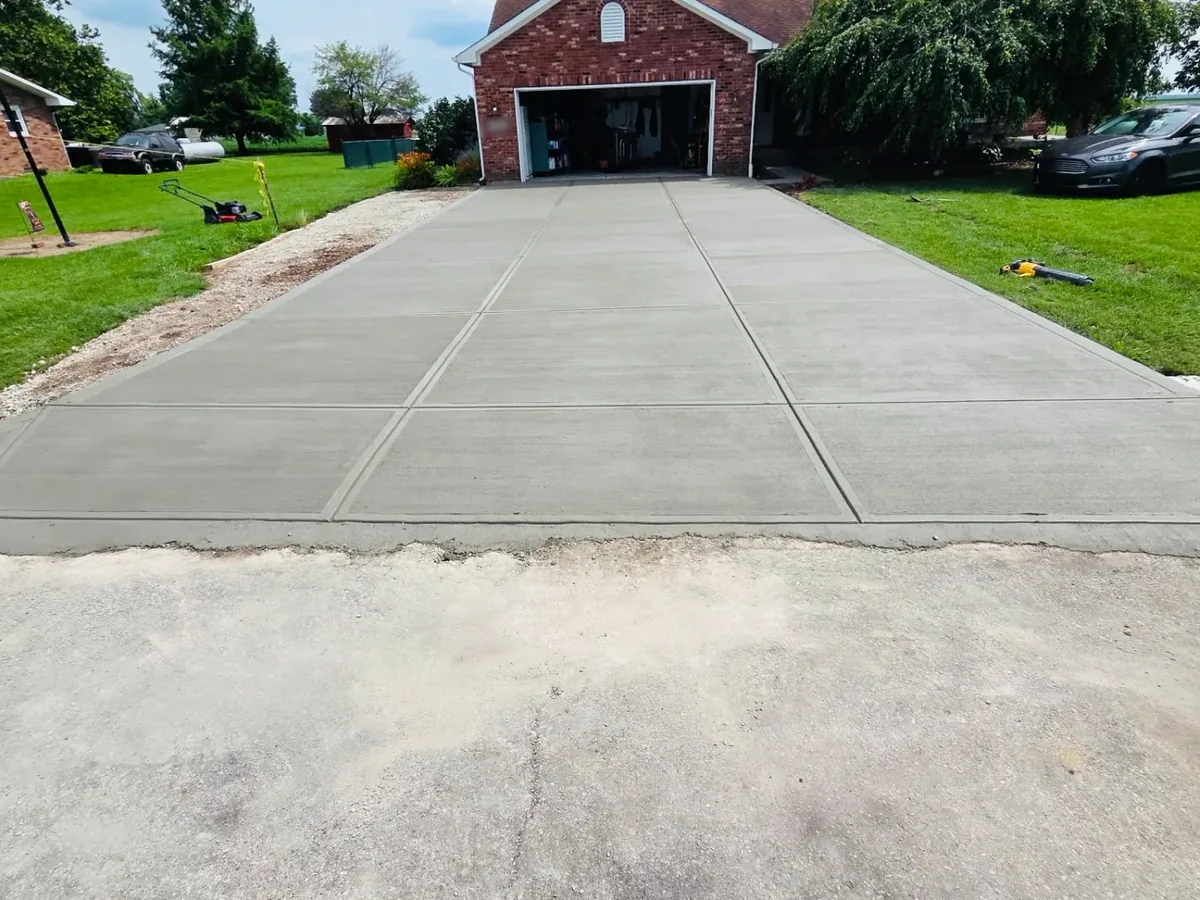
After the concrete is floated flat, a push broom is drawn across the surface. The ready-mix association calls for this texture on driveways, patios and sidewalks. It gives a non-slip surface. A smooth, steel-troweled face turns slippery when wet.
The broom finish also keeps the price down. The national concrete guide names it the least costly patio finish. Grip matters on a wet driveway, and summer here is wet.
Will a new concrete driveway crack?
It can. The ready-mix association says cracks in concrete cannot be prevented entirely. Well-designed joints control them and keep them small.
The grooves across a new slab are control joints. The same guidance caps joint spacing at 24 to 36 times the slab’s thickness. On a 4-inch slab, that is about 10 feet. It also recommends no more than 15 feet on any slab.
Each joint should be cut at least a quarter of the way through the slab. Steel helps in a different way. Mesh or rebar does not stop a crack, but it helps hold the crack together. Ask each quote where the joints will go.
How long does concrete take to cure in Florida heat?
Curing means keeping new concrete moist while it gains strength. The ready-mix association says curing typically runs 3 to 7 days. Concrete left to dry out can lose as much as 50 percent of its potential strength.
Heat makes this harder. Hot weather dries the surface fast and makes concrete set sooner, the association says. A summer pour here calls for a plan to keep the slab damp.
Do you need a permit for a concrete driveway near Orlando?
It depends on the address, so treat this as a starting point. Inside Orlando city limits, the city lists an Engineering Permit Application for driveways. In unincorporated Orange County, the county says a permit is required any time you pour concrete. There, a driveway is normally reviewed as a Right-of-Way Permit.
In St. Cloud, any work within the right-of-way needs Public Works and Engineering approval. If your HOA reviews exterior changes, get its approval before the work starts. Check with the building department for your address too.
What does a concrete patio cost?
The national concrete guide puts a typical 288-square-foot patio at an average of $3,200. That is about $11 a square foot. Another national guide lists concrete patios from about $4 a square foot, rising to $26 depending on what you pick.
A patio follows the same steps as a driveway: a compacted base, forms, joints and a broom finish. We pour patios and walkways, plus the slab under a full masonry outdoor kitchen.
Is mud-set brick a good upgrade from plain concrete?
Mud-set brick starts with a concrete slab. Then real clay brick is set in a mortar bed on top. A Brick Industry Association technical note says mortar-set pavers belong only over a concrete base. It calls for that base to be at least 4 inches thick.
So mud-set brick costs more than plain concrete, since you pay for the slab and the brick. We pour the slab and lay mud-set brick pavers for patios, walkways and driveways. Our guide to mud-set brick covers the trade-offs.
How do you get a real price for your driveway?
Measure the length and width, and note what will park on it. Ask each quote to list the thickness, the steel, the joint layout and the base work. Ask about tear-out and the apron too.
We are based in St. Cloud and pour broom-finish driveways across Greater Orlando. See our concrete driveways and patios for the work we do. We look at the space and give you a quote. Call (407) 702-4316.